
Commercial Dishwasher Not Working? Here’s What to Check First
We service commercial dishwashers across Bridgewater, Somerville, Raritan, Branchburg, and Hillsborough Township — restaurants, cafeterias, catering kitchens, school facilities, and commercial operations throughout Somerset County — and most of the calls we get fall into a handful of predictable failure patterns.
Here’s how to troubleshoot the most common issues before calling anyone and when the problem genuinely needs a technician.
What Is the Most Common Reason a Commercial Dishwasher Stops Working?
A commercial dishwasher that stops working, won’t start, isn’t heating, or isn’t draining can shut down an entire kitchen operation within minutes. The most common causes we find on service calls across Somerset County — in order of frequency:
Clogged Strainer or Drain Filter
This is responsible for the majority of commercial dishwasher calls we get. The strainer at the bottom of the wash tank catches food debris every cycle. When it’s not cleaned daily, it restricts drainage, reduces cleaning performance, and eventually causes the machine to fault or stop mid-cycle. Pull the strainer, clean it, and reinstall before assuming anything mechanical has failed.
Low Water Temperature
Low water temperature results in poor cleaning performance and unhygienic dishes. Check the water heater thermostat settings and ensure they are set to the appropriate temperature — around 140°F for the wash cycle. A machine that’s running but not hitting temperature will pass dishes through without sanitizing them, which is both a health code issue and a sign the heating element or booster heater needs attention.
Door Switch or Interlock Failure
A faulty door switch or selector switch is one of the most common reasons a commercial dishwasher won’t start. The machine won’t run if the door sensor doesn’t register a complete close. Check that the door is fully latching and the gasket isn’t preventing full closure before assuming an electrical failure.
Water Supply Issue
A closed or partially closed supply valve, a kinked incoming line, or insufficient water pressure will prevent the machine from filling properly — causing it to fault at the start of a cycle. Check the supply valve behind or near the unit is fully open before anything else.
Chemical Dispensing Failure
Detergent and rinse aid dispensers clog or fail over time. A machine running without proper chemical dosing won’t clean or sanitize effectively — dishes come out with residue, spots, or a film that gets worse over time.
My Commercial Dishwasher Isn’t Heating Up — What’s the Problem?
Heating failure is the most serious commercial dishwasher problem from a health code standpoint. A machine not reaching proper wash and rinse temperatures isn’t sanitizing — full stop. Somerset County health inspections take temperature compliance seriously, and a machine running below spec is a violation waiting to happen.
Wash Water Not Hot Enough
Points to the water heater thermostat, a failed heating element inside the wash tank, or incoming water that isn’t hot enough from the building’s supply. Check the incoming supply temperature at the machine before assuming the heating element has failed.
Final Rinse Not Hot Enough
On high-temp dishwashers, a failed booster heater is almost always the cause. The booster heater takes incoming hot water and raises it to the 180°F required for the final sanitizing rinse. When it fails, the wash cycle runs fine but the final rinse never reaches sanitizing temperature.
No Heat at All
A tripped thermal cutout or a completely failed heating element. Some commercial dishwashers have a thermal cutout that trips when the machine overheats — check the reset button on the heating circuit before calling for service.
If your machine has a temperature display and you’re seeing wash or rinse temperatures below spec, that’s a health code issue that needs professional attention the same day. Log the problem with time and temperature readings and stop operating the machine on that cycle until it’s repaired.
Commercial Dishwasher Not Draining
Standing water in the wash tank at the end of a cycle means the drain system isn’t clearing. Start with the strainer and scrap screen — these need to be cleaned after every service period, not just daily. If those are clear, check the drain hose routing for kinks or pinched sections.
In Somerville and Bridgewater restaurants connected to grease traps, a clogged trap is frequently the actual cause of commercial dishwasher drainage issues — something we check on every drainage call in these areas. If operator checks don’t clear it, a drain pump or level sensor problem is the likely cause and needs professional diagnosis.
Commercial Dishwasher Not Cleaning Dishes Properly
The number one cause is failure to scrape and pre-rinse before loading. Commercial dishwashers are powerful but they’re not garbage disposals — heavy food debris left on dishes overwhelms the strainer and spray pattern.
Beyond that, check the spray arms. The spray arm nozzles on commercial dishwashers clog with mineral deposits from hard water over time. New Jersey has moderately hard water, and across our Somerset County service area — Bridgewater, Branchburg, Hillsborough Township — we consistently find mineral buildup on spray arms as a contributing factor to poor cleaning performance, especially in operations that haven’t been descaling regularly. Remove the arms and rinse the nozzles clear. Use a rinse aid to break surface tension and allow water to sheet off dishes.
What Is the Average Lifespan of a Commercial Dishwasher?
Lifespan depends significantly on machine type and maintenance. Undercounter models typically last 7 to 10 years, door-type machines 8 to 12 years, conveyor machines 10 to 15 years, and flight-type machines 12 to 20 years.
The key variable is maintenance. Regularly changing the tank water, cleaning the filter, and washing out the unit can extend a commercial dishwasher’s lifespan to 15 years or more. Operations that run the machine hard without daily cleaning, regular descaling, and periodic professional service will see failures well short of those ranges.
The repair vs replace decision follows a straightforward rule: if annual repair costs are approaching 50% of the replacement cost of a comparable unit, replacement is worth serious consideration. A single repair on a well-maintained 8-year-old door-type machine is almost always worth doing. Recurring repairs on a 12-year-old undercounter that’s past its expected lifespan is a different conversation — and one we’re always honest about with our customers in Bridgewater and across Somerset County.
Recent Repair: Commercial Dishwasher in Somerville, NJ
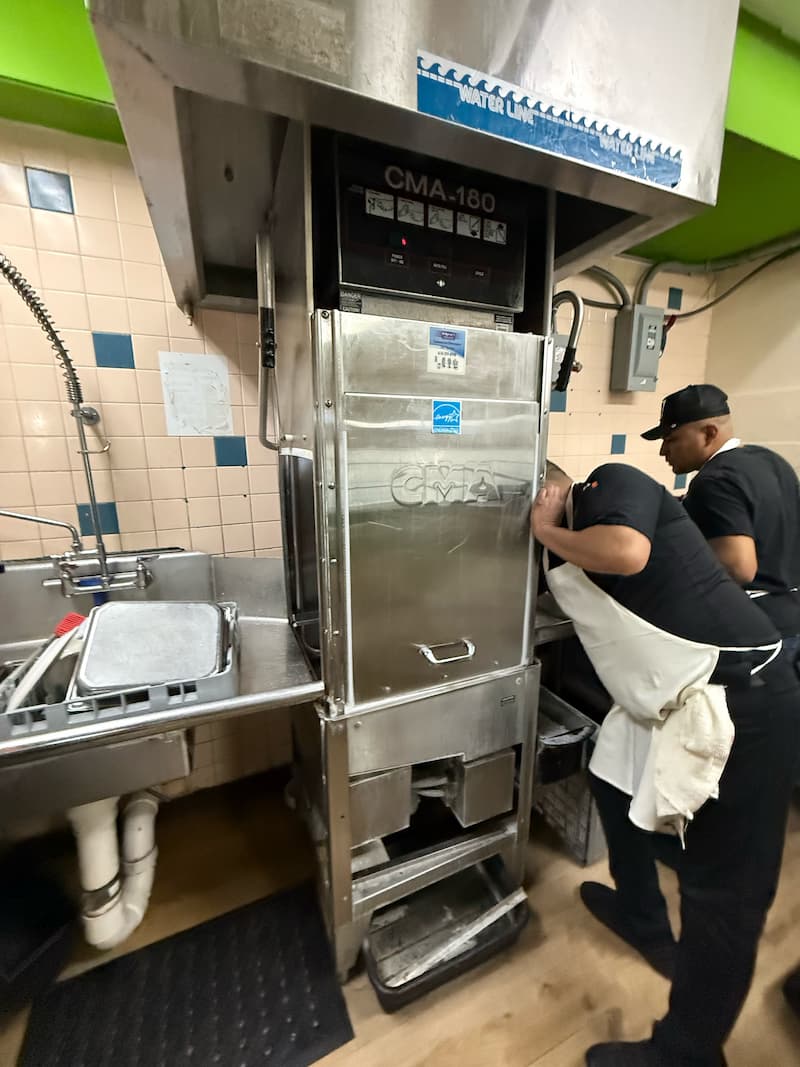
A restaurant in Somerville called us mid-service about a commercial dishwasher that had stopped completing its cycle. The machine would start, run partway through the wash, then fault out and stop. The kitchen had been hand-washing dishes for two hours by the time we arrived.
Our technician found the strainer packed solid with debris and the drain pump straining against restricted flow. The machine was faulting because it couldn’t drain fast enough to progress to the rinse cycle. We cleared the strainer and drain line, ran a full test cycle to confirm normal operation, and reviewed the daily cleaning procedure with the kitchen manager before leaving.
Total time on-site: under 45 minutes. No parts needed. The machine had been running without daily strainer cleaning for several weeks. A $0 maintenance task had turned into a two-hour hand-washing operation during a lunch service.
When Should I Call a Professional?
You can handle yourself: cleaning the strainer and scrap screen, checking the door latch, confirming the water supply valve is open, checking incoming water temperature, inspecting spray arms for mineral buildup.
Call us if: the machine isn’t reaching wash or rinse temperatures — this is a health code issue, not just a performance issue. Also call if the drain isn’t clearing after operator checks, the machine won’t start after confirming power and door latch, or you’re seeing error codes that don’t clear with basic troubleshooting.
We service commercial dishwashers across Bridgewater, Somerville, Raritan, Branchburg, and Hillsborough Township. Most commercial dishwasher calls are diagnosed and repaired in a single visit. We prioritize same-day service for commercial calls because we understand what downtime costs a kitchen during service hours.
Commercial Dishwasher Not Working?
We prioritize same-day commercial calls because we understand what downtime costs a kitchen. We’re local, we carry common commercial dishwasher parts, and we can usually be there the same day.
Featured Articles
Refrigerant Leak in Your Refrigerator: Signs, Causes, and What to Do
Learn More
How Often Should You Clean Refrigerator Coils? (And What Happens If You Don't)
Learn More
Whirlpool Washer Not Filling With Water? Here’s What We Find
Learn More
.svg)
%201.svg)