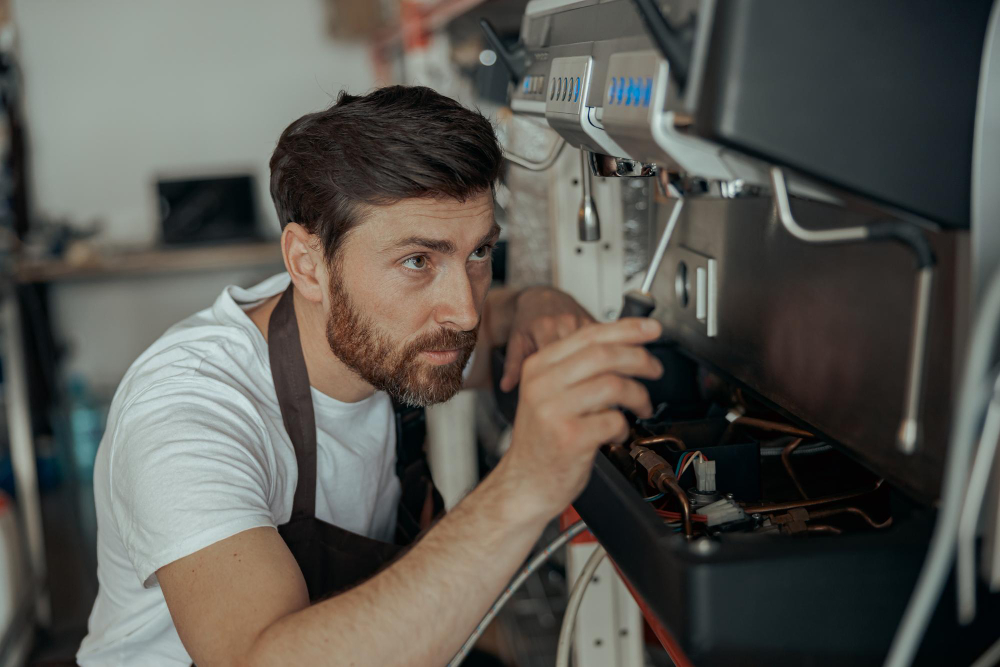
Coffee Machine Not Working? Here’s What We Usually Find
If your coffee machine has stopped working, the most common causes are limescale buildup blocking the pump or heating element, a failed pump, a worn group head gasket on espresso machines, or a tripped internal thermostat. Most coffee machine issues boil down to one of these four factors, and in most cases, the machine is worth repairing rather than replacing.
We repair coffee machines and espresso machines across Bridgewater, Hillsborough Township, Somerville, Raritan, and Branchburg. Here’s what we find on most calls — and what you can check before picking up the phone.
Why Does Hard Water Matter for Coffee Machines in NJ?
Somerset County, like the rest of New Jersey, has moderately hard water. Every cup you brew creates a small mineral deposit inside the machine, including the heating element, the pump, the boiler walls, and the brew path. Over time, this buildup restricts water flow, reduces pressure, lowers brewing temperature, and eventually stops the machine entirely.
This is not a defect. It's chemistry, and it's entirely preventable with regular descaling. Most of the coffee machine calls we receive in Bridgewater and Hillsborough Township are related to machines that have not been descaled in a year or more. A machine that would have run fine for another five years with basic maintenance now requires a pump or heating element replacement because the scale was not addressed.
What to Check First When Your Coffee Machine Isn't Working
There is no water coming out
The most common cause is a clogged pump or a blocked brew path due to limescale. The pump attempts to run but is unable to push water through the scale buildup. You may hear the pump operating—sometimes louder than usual—but no water appears at the group head or spout.
The second most common cause is an airlock, which occurs when air becomes trapped in the pump after the water tank has run dry or been removed. On many machines, this is resolved by briefly running the steam wand to prime the pump before attempting to brew.
The machine won't turn on
If the machine is completely dead—no lights, no response—check the power supply and circuit breaker first. Many coffee machines include an internal thermal safety cutout that activates when the machine overheats. This is especially common when machines are left running unattended or stored without being emptied. The reset location varies by brand; many machines have a small button accessible from the bottom of the unit.
If the power checks out and the machine still won’t respond, the control board or main switch has likely failed and needs professional diagnosis.
Coffee or Espresso Is Lukewarm
Low brewing temperatures almost always result in limescale on the heating element. The element is still functional, but the scale coating acts as an insulator, limiting the temperature it can deliver to the water. A thorough descale cycle frequently resolves this completely. If the temperature remains low after descaling, it indicates that the thermostat or heating element has failed.
Weak Pressure or Slow Extraction on Espresso Machines
Espresso machines depend on precise pressure — typically 9 bar — to extract properly. Weak or slow shots almost always mean the pump is losing pressure from scale buildup or wear, or the group head gasket has hardened and is no longer sealing properly. A hardened gasket allows pressure to escape around the portafilter rather than through the coffee, producing weak, watery shots and often a hissing sound when the machine is under pressure.
Group head gaskets are one of the most common espresso machine repairs we perform. They’re a wear item — they harden and crack over time regardless of how well the machine is maintained — and replacing them is a routine repair that restores full extraction pressure.
Machine Is Leaking Water
Leaks from a coffee machine most commonly come from a cracked or hardened group head gasket, a loose water line connection, or a solenoid valve that’s failing and not closing fully between shots. On bean-to-cup machines, a cracked internal water line is another common source. A leak that gets worse over time rather than staying the same is almost always a component that’s actively failing rather than just loose.
Grinder Not Working on Bean-to-Cup Machines
Bean-to-cup machines, including Jura, De'Longhi, Miele, and Breville, have integrated grinders that fail due to oily bean residue coating the burrs, worn burrs that no longer grind consistently, or a grinder motor that has reached the end of its service life. Signs include louder-than-usual grinding noise, inconsistent grind output, and the machine brewing but producing thin, under-extracted coffee despite proper settings.
Is It Worth Repairing a Coffee Machine?
For quality espresso machines and bean-to-cup machines — Jura, De’Longhi, Breville, Miele, La Marzocco — repair is almost always the right call. These machines cost $500 to $3,000 or more new, and most common failures — pump, gasket, thermostat, heating element, grinder burrs — are a fraction of replacement cost.
For basic drip coffee makers under $100, the repair math often doesn’t work. We’ll tell you that honestly before you commit to anything.
De’Longhi Espresso Machine Repair in Hillsborough Township
A homeowner in Hillsborough Township called us about a De’Longhi espresso machine that had been producing weak, watery shots for several weeks before stopping altogether. The machine was about four years old and used daily.
Our technician found two issues: a heavily scaled heating element reducing water temperature, and a hardened group head gasket that had been leaking pressure around the portafilter for some time. We descaled the machine thoroughly, replaced the group head gasket, and ran a full extraction test to confirm pressure and temperature were back to spec.
When Should I Call a Professional?
You can handle yourself: running a descale cycle if you haven’t done one recently, checking the water tank is seated properly, clearing a steam wand blockage, checking the power connection and breaker.
Call us if: the machine won’t power on after basic checks, no water flows despite a full tank and a recent descale, shots are weak after descaling, the machine is leaking, or the grinder is producing inconsistent results on a bean-to-cup unit.
We service all major coffee machine brands — De’Longhi, Jura, Breville, Miele, Nespresso, Saeco, Gaggia, and more — across Bridgewater, Hillsborough Township, Somerville, Raritan, and Branchburg.
ProFix Coffee Machine Repair — Bridgewater, Hillsborough Township, Somerville, Raritan & Branchburg, NJ
Coffee machine not working? Before buying a new one, give us a call. Most coffee machine problems are fixable on the first visit — and far cheaper than a replacement.
Featured Articles
Treadmill Not Turning On? Here’s What We Usually Find
Learn More
Hot Tub Not Heating? Troubleshooting Guide for Somerset County Homeowners
Learn More
Emergency Appliance Repair in Bridgewater & Somerset County, NJ
Learn More
.svg)
%201.svg)